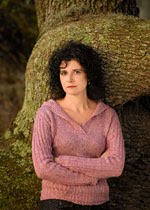
I've been a less faithful blogger lately, because my mother has been very ill. We lost her last week. Being a writer, I felt a need to set down some of my memories of her, so I hope you don't mind if I stray from the topic of this blog, just for today.
As we were planning her funeral service, the minister asked my sister and me some questions about our childhood and about our memories of Mama. Then he asked for something brief that captured her spirit, perhaps something that we could imagine carved on her tombstone. I really couldn't think of anything to tell him, except for the word, "Mother."
Since I am a novelist, any effort to expand her description beyond a single word naturally metamorphosizes into many, many words. Since she was a singularly beautiful woman, that description naturally includes photographs. Here are those words and pictures.
My mother Lillian was born in January 1937, almost exactly one year after her sister. Two years later, their mother was dead of one of those things that don't kill healthy young women any more, pneumonia. I'm told that someone was driving frantically to Mobile, hoping to find one of those miraculous new antibiotics, a sulfa drug, but he didn't get back in time. She was 26.
Before their mother died, she made two special little dresses,one pink and one blue. I've never seen any like them. They were made of maybe 30 triangles of silk that were connected by flat strips of white insertion lace to make the dresses' skirts. The strips of lace extending from the skirt were sewn together at the top to form the dresses' bodices. I'm told that my grandfather helped her make them. She basted them together while he, being a mechanical engineer and thus handy with things that had motors, ran the sewing machine.
This picture of the girls wearing the dresses was probably taken after their mother died.
By the time I was born, the dress was too fragile to wear, so my mother copied it in pink cotton batiste. My sister and I both wore the copy. When my girls were born, Mama gave it to me, and they both wore it. I think it's still in good enough shape for my granddaughter to wear after she's born in January, but I have a hankering to see if I can engineer yet another copy. We'll see if I work up enough nerve to give it a try.
As a Mother's Day gift a few years ago, my sister and I had the original dress cleaned and mounted in a shadow box, along with photos of all the girls who wore it or the copy, as well as the grandparents who made the original. We included our sons' photos, not because they wore the dress, but just because we kinda like them. :-) Here's a crummy photo of the contents of that shadowbox.
Maybe I'm losing my mind, but look at this photo. I just propped the frame against the wall, sat on the floor, and snapped the shot with my phone, so you can see the reflection of everything in the room in the glass.
Look for my reflection. You can see my white shirt and dark hair. Do you see the reflection of someone else wearing a slightly darker blouse partially obscuring mine? It looks an awful lot like the blouse we buried my mother in. I've always had the traditional engineer's skeptical approach to the metaphysical, but I really can't think of anything to explain that picture.
Here's a photo of the last little girl to wear the current copy, my younger daughter, along with her mother, grandmother, sister, aunt, and godmother.

It was perhaps destined that my mother would be an operating room nurse, because there is a story that she and her cousin had a big fight over a worm they found, because she wanted to cut it open and see what was inside, and he wasn't sure that was a good idea. She told me that she'd read everything in her high school library before she graduated, and I know that she was blessed with determination, because Daddy told me that her Daddy took him aside before the wedding to warn him that she "butts with her own head." So I am not surprised that she was at the top of her nursing school class, graduating with an RN license that was a lifelong source of pride. She was in charge of the OR by the time she was 25, and the doctors liked working with her because she was cool, and because she was smart, and because she taught herself to cut sutures with her left hand the very night after she saw that it was a useful skill to have. I love this photo of her as a student nurse in the mid-1950s, especially the open door on the nursing dormitory behind her.

Many years later, I was asked to contribute a story to a very noir publication. Since modern noir connotes a bit more blood-and-guts than I typically write, I pondered a while on this story. Then I decided that I didn't have to take this story onto mean streets that I knew nothing about. It stood to reason that there should be plenty of blood-and-guts in an operating room. And I thought a 1950s-era OR would be even more noir. Mama was so enthusiastic in helping me get the setting of the story right, to the extent of mailing me her old textbooks, that I gave her co-author credit for "Starch," which you can find here:
http://www.amazon.com/Starch-ebook/dp/B003EEN1EQ/ref=sr_1_3?ie=UTF8&m=AG56TWVU5XWC2&s=digital-text&qid=1297702260&sr=1-3
While in nursing school, she met Daddy. Since people are at their most beautiful when they're in love, I'm including two photos from 1956, one of the two of them at a Christmas party and one that he took of her at Audubon Park in New Orleans while she was training at Charity Hospital.
They married immediately after her 1957 graduation in a small ceremony at the parsonage. Afterward, she was an OR nurse and he did sales for a tobacco company until he finished college, thanks to the GI Bill. Daddy got a job at the Kaiser Aluminum plant where he was eventually plant manager until he retired at age 52.

A sympathy note I received this week mentioned that my father "had personality coming out his ears," and he did. I'm told that the brass at Kaiser Aluminum didn't know what to do with this slow-talking man who would say absolutely anything he pleased to them and who could get away with it, because he had the charm and looks of a Hollywood star. And because he knew he could run his plant so that it was eternally profitable. And also because he knew that nobody else wanted to go live someplace obnoxious like Mississippi and they'd have to do that if they fired him. And the final reason he never kissed up to his bosses was because he had no interest in moving further up in the company, not if it meant that he'd have to move his family someplace obnoxious like New Orleans or Oakland or Gary, Indiana.
My father never met a stranger, and he liked to tell about the time he was dressed all slick in a suit and tie, flying cross-country to a corporate meeting in Oakland. He chatted with the Yankee lady in the seat next to him for the entire flight, and he used his college English and his company manners and everything, but she apparently never got past the accent. As the plane landed, she asked, "Pardon me, sir...but are you a hick?"
He just grinned and said, "Yes, ma'am. I are."
Mama stopped working and commenced mothering when I came along in 1961. This picture was taken in 1963, while she was pregnant with her second and last child, my sister. So, technically, we're all three in the shot.

Mama made virtually everything we wore during our growing-up years, and I'm still spoiled by the experience of strolling into a fabric store, picking out a dress pattern and asking if she could put on a different sleeve, then picking the fabric and color that suited me. She cooked a hot meal and we ate as a family every night. And we washed every meal but breakfast down with her iced tea. Everybody loved her cooking, but there must be something on the y-chromosome that responds to southern cooking. It didn't matter where he came from, if a man sat down at my mother's table, he drank a gallon of that tea and he ate her potato salad until he hurt himself. She passed those recipes on to me, and I've handed them on to all three children. Her interest in sewing seems to have stopped with me and my sister, however.
Here are two pageant gowns she sewed for me. The first one was made from fabric we bought at a fire sale. The other girls had department store dresses, but I won the pageant
and the evening gown competition. For the state pageant, we found a photo of a dress we liked, then she copied it, using a pattern that really didn't look much like the original dress at all. Notice how perfectly the bodice fits and know that one of my shoulders is lower than the other and one hip is higher than the other and that I weighed ninety pounds at the time. Have I mentioned that I am spoiled when it comes to shopping for clothes?
It became apparent early on that my sister and I...um...weren't ordinary. There were no gifted programs in elementary schools back then, but she'd heard about such things being offered through the university education department. She consulted with our pediatrician, Dr. Mary Clark, who probably knew quite a little bit about being unordinary, since she was already middle-aged by that time and there couldn't have been many women in med school with her.
Dr. Mary showed the southerner's typical disdain for hiring experts to do things that can be addressed through common sense. She told her to encourage any interest we showed and to fill the house with books. She took us to the bookmobile in the summers and all three of us left with stacks of books. The archaeology books passed through all of our hands, and they are probably the reason I write what I do. That, and the fact that my mother excavated some really cool stuff out of the trash pit left in the woods behind our home by the residents of a long-gone house. Also, she found some arrowheads and the quarry where their stone was dug in those very same woods.
My mother was there for me during all the little bumps in my road, and the biggest of those was probably my second child's premature birth. She and Daddy took my little son to their house and brought him to see me on weekends. Every week, Mama would go to the hospital, check out the baby, and pronounce that the doctors were wrong. (My sister and I have always said that if she'd been born in 1967, instead of 1937, she would have been a doctor herself.) She declared that this baby was going to be fine. Here she is, holding my daughter when she was three months old and nearly ready to leave the hospital. She kept stretching her arms out and waving her little hands in the air. The doctors said it was a reflex and maybe a sign of brain damage. Mama said that the baby was just saying, "Look at my pretty hands!" Mama was right. And my daughter's hands really are pretty...

After my daughter got out of the hospital, my father liked to carry her around and introduce her to strangers by saying, "See this little thing? She weighed a pound and ten ounces when she was born! Just look at her!" He was also ridiculously proud of his daughters, bragging about my sister's PhD in chemistry and my master's in chemical engineering by saying, "All my boys was girls." (He frequently dispensed with the college English when he thought Mississippi talk did a better job of getting his point across.) He died of lung cancer at 58 in 1992.
Mama carried on alone, though it must have been hard. After they'd been married about 25 years, one of his friends asked my father if he'd seen the really beautiful woman who'd walked into church that morning. Daddy said, "Really, I think my wife is the most beautiful woman there is." I wish they'd had more than 34 years together.
My mother was diagnosed with breast cancer in 1998. When the biopsy came up positive, I carefully packed my suitcase for the trip to Mississippi...then left it on my living room floor. I had to borrow underwear until her surgery was over and I could take time to run to Walmart.
After the diagnosis, I told her we'd take a trip when she got finished with her chemo. Because we loved archaeology and science so much, I found us a cruise that started in Athens, went to ruins in Turkey and Romania, then stopped in the middle of the Black Sea to view a total eclipse of the sun. Here we are embarking on our adventure and viewing the eclipse in our matching flamingo shirts.
She went on to have many years of remission and then manageable disease until the cancer took her last week, but it was on that trip that I first sensed that responsibility was being passed to me. It was a strange feeling.
Before my son's wedding in March 2009, Mama's doctor told me that she would not see my daughter's wedding in September of that year. She made him into a liar, then she lived more than another year, just to show she could. Her father did say that she butted with her own head. Here she is, making her entrance on my son's arm at that wedding she wasn't supposed to see.
I think the greatest gift our parents gave my sister and me was the fact that they never once suggested that there was anything we could not do. When you realize that I'm talking about 1960s Mississippi, a place where few people considered that girls might want to do much of anything, I think that their attitude was extraordinary.
To sew a lovely bit of trim on all this remembering, here is a photo from Christmas 1963, when I got my first piano and my infant sister lay on a blanket under the tree and Daddy caught Mama in her flannel pajamas. All Christmases should be like this one, and all childhoods should be like mine.


 , I wrote about a deadly cyber-stalker circling a pop star and an oil company exec found shot through the head with a farewell note beside her body. Was it suicide? I’m not telling, but I will say that both plot lines tied back cases I’d heard about but never wrote about back in the early nineties. So their roots are real, even though they’re thoroughly fictionalized in the book.
 ? The African symbols and the sugar cane plantation in the book? All modeled after real places and archeological finds within an hour of my house. The location where the book builds to a climax? You guessed it. Real.


 ...